Trombosis asociada al cáncer
Cancer-associated thrombosis: Understanding blood clot risks for patients with cancer
Patients with cancer face a significantly higher risk of developing serious blood clots compared to the general population. Cancer-associated thrombosis, medically known as venous thromboembolism (VTE), affects approximately one in every 200 cancer patients and represents the second leading cause of death in cancer patients after disease progression.
VTE encompasses two dangerous conditions: deep vein thrombosis (DVT), which occurs when blood clots form in deep veins, and pulmonary embolism (PE), when clots travel to the lungs. Together, these conditions create a potentially deadly medical emergency that requires immediate attention.
Why cancer increases blood clot risk
Cancer cells naturally release chemicals that make blood stickier and more likely to clot. Several risk factors typically coexist in cancer patients, creating a perfect storm for thrombosis development:
- Active cancer therapy, including certain chemotherapies
- Surgical procedures
- Hospital admissions and immobility
- Central venous catheters for treatment delivery
- Obesity and hormone replacement therapy
When chemotherapy kills cancer cells, certain substances that promote clotting are released directly into the bloodstream. Some chemotherapy drugs carry higher clotting risks than others, making treatment selection crucial for prevention.


High-risk cancer types
While the exact reasons remain unclear, certain cancers are associated with significantly higher thrombosis risk:
- Cáncer de pulmón
- Cáncer de riñón
- Cáncer de cerebro
- Linfoma
- Cáncer de ovario
- Cáncer de páncreas
Three key factors determine your blood clot risk
Your likelihood of developing cancer associated thrombosis depends on three main factors:
- Type of cancer you’re diagnosed with
- How your cancer is being treated
- Your level of physical activity
Staying active helps keep blood moving through your veins, reducing the likelihood of clot formation in the first place.
Prevention and treatment options
If you have cancer, discuss your VTE risk with your doctor. The best prevention approach depends on your specific cancer type, treatment plan and whether you’re hospitalized or at home.
Your doctor may recommend:
- Anticoagulant medications (commonly called “blood thinners”)
- Compression stockings that improve blood flow
- Intermittent pneumatic compression devices that automatically squeeze your legs to keep blood moving
Getting specialized care
Cancer-associated thrombosis requires specialized treatment that balances blood clot management with ongoing cancer care. Early recognition and proper treatment are essential for maintaining quality of life and improving survival outcomes.

Cancer-associated patient resources
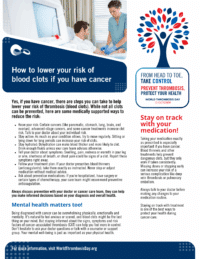
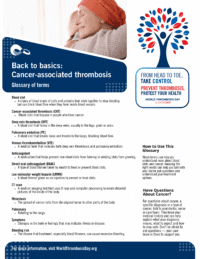
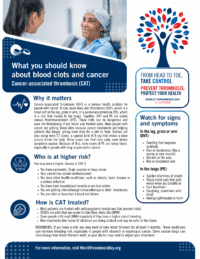
International cancer resources for patients
- American Cancer Society (ACS)
www.cancer.org
Reliable, easy-to-understand information on types of cancer, treatments and support services. Available in English and Spanish. - Union for International Cancer Control (UICC)
www.uicc.org
A global organization uniting the cancer community to reduce the burden of cancer worldwide. Offers advocacy tools and patient education. - World Health Organization (WHO) – Cancer Program
www.who.int/health-topics/cancer
Global information on cancer prevention, early detection and treatment. Offers materials in multiple languages. - International Agency for Research on Cancer (IARC)
www.iarc.who.int
Part of WHO, IARC focuses on cancer research, causes and prevention. Includes global cancer statistics and data. - Cancer Atlas
www.canceratlas.cancer.org
An interactive tool with maps, graphics and facts about global cancer trends and risk factors. Developed by ACS, UICC and IARC.

Research on cancer-associated thrombosis from the
International Society on Thrombosis and Haemostasis (ISTH)
- Streiff MB et al.
“Cancer-Associated Thrombosis Version 2.2021 NCCN Clinical Practice Guidelines in Oncology”
Journal of the National Comprehensive Cancer Network. 2021. - Wang TF et al.
“Trends in Cancer-Associated Thrombosis in the U.S. 2005–2020”
JAMA Oncology. 2023. - Khorana AA et al.
“Incidental Pulmonary Embolism in Cancer Patients: Clinical Significance and Management”
Journal of Clinical Oncology. 2020. - Spyropoulos AC et al.
“Direct Oral Anticoagulants Versus Low-Molecular-Weight Heparin in Cancer-Associated Thrombosis”
Blood Advances. 2022. - Weitz JI et al.
“Factor XI Antisense Oligonucleotide for Prevention of Venous Thrombosis”
New England Journal of Medicine. 2015. - International Society on Thrombosis and Haemostasis.
“Hemostasis and Malignancy Bibliography – Official ISTH SSC Subcommittee Communications.” 2024. - International Society on Thrombosis and Haemostasis.
“ISTH Published Guidance by Topic – Cancer and Thrombosis.” 2025. - Streiff, M.B., et al.
“Update on Guidelines for the Management of Cancer-Associated Thrombosis.” The Oncologist, Vol. 26, No. 4, April 2021, pp. e24–e40. - International Initiative on Thrombosis and Cancer (ITAC) Advisory Panel.
“2022 International Clinical Practice Guidelines for the Treatment and Prophylaxis of Venous Thromboembolism in Patients with Cancer, Including Patients with COVID-19.” The Lancet Oncology, Vol. 23, No. 7, July 2022, pp. e334–e347. - Martin, K.A., Molsberry, R., Khan, S.S., et al.
“Preventing Venous Thromboembolism in Oncology Practice: Use of Risk Assessment and Anticoagulation Prophylaxis.” Research and Practice in Thrombosis and Haemostasis, Vol. 4, No. 7, October 2020, pp. 1211–1215. - Samuelson Bannow, B.T., Lee, A., Khorana, A.A., Zwicker, J.I., Noble, S., Ay, C., & Carrier, M.
“Management of Cancer-Associated Thrombosis in Patients with Thrombocytopenia: Guidance from the SSC of the ISTH.” Journal of Thrombosis and Haemostasis, Vol. 16, No. 6, June 2018, pp. 1246–1249. - Wang, T.F., Zwicker, J.I., Ay, C., Pabinger, I., Falanga, A., Antic, D., Noble, S., Khorana, A.A., Carrier, M., & Meyer, G.
“The Use of Direct Oral Anticoagulants for Primary Thromboprophylaxis in Ambulatory Cancer Patients: Guidance from the SSC of the ISTH.” Journal of Thrombosis and Haemostasis, Vol. 17, No. 10, October 2019, pp. 1772–1778.
Obtenga apoyo

Blood clot signs and symptoms you can’t ignore
Many patients with cancer don’t realize they’re experiencing blood clot symptoms until it’s too late – but recognizing these warning signs could save your life. From subtle leg changes to sudden breathing difficulties, blood clots in cancer patients often present differently than you might expect. Don’t wait until an emergency: learn the critical symptoms every cancer patient should know and when to seek immediate help.

Referencias de la página:
- “Preventing VTE in hospitalized patients with cancer.” Brown, A. American Journal of Health-System Pharmacy, Vol. 69, No. 6, 2012, pp. 469-481.
- “Risk of venous thromboembolism in patients with cancer: a systematic review and meta-analysis.” Horsted, F., West, J., & Grainge, M. J. PLoS Medicine, Vol. 9, No. 7, 2012, e1001275.
- “Arterial and venous thrombosis in cancer patients.” Blann, A.D., et al. Cardiology Research and Practice, Vol. 2011, 2011, pp. 1-12.
- “Mechanistic view of risk factors for venous thromboembolism.” Reitsma, P.H., Versteeg, H.H., & Middeldorp, S. Arteriosclerosis, Thrombosis, and Vascular Biology, Vol. 32, No. 3, 2012, pp. 563-568.
- “Prevention of Deep Vein Thrombosis and Pulmonary Embolism.” Goldhaber, S. & Fanikos, J. Circulation, Vol. 110, 2004, pp. e445-e447.
- “Thromboembolism is a leading cause of death in cancer patients receiving outpatient chemotherapy.” Khorana, A.A., et al. Thrombosis and Haemostasis, Vol. 5, 2007, pp. 632-634.
- “Cancer-Associated Thrombosis Patient Resources.” Thrombosis Canada, 2019.
- “Does Cancer Cause Blood Clots?” Dana-Farber Cancer Institute Blog, 2014.
- “Blood Clots and Cancer: Risk Factors and Prevention.” CancerClot Patient Education, 2024.
- “Psychological impact of cancer-associated thrombosis diagnosis on patients and families.” NCBI PubMed Database, 2024.